Introduction: Starting a Business in the UK in 2027
Starting a business in the United Kingdom can be an exciting opportunity to turn your skills, experience or ideas into a source of income. Whether you want to launch a small online shop, offer freelance services, open a local service business or build a company with long-term growth potential, the right preparation can help you make more informed decisions.
You do not necessarily need a large investment or a commercial premises to begin. Some businesses can start from home with a laptop, an internet connection and a clear plan. Others require specialist equipment, insurance, stock, licences or professional training.
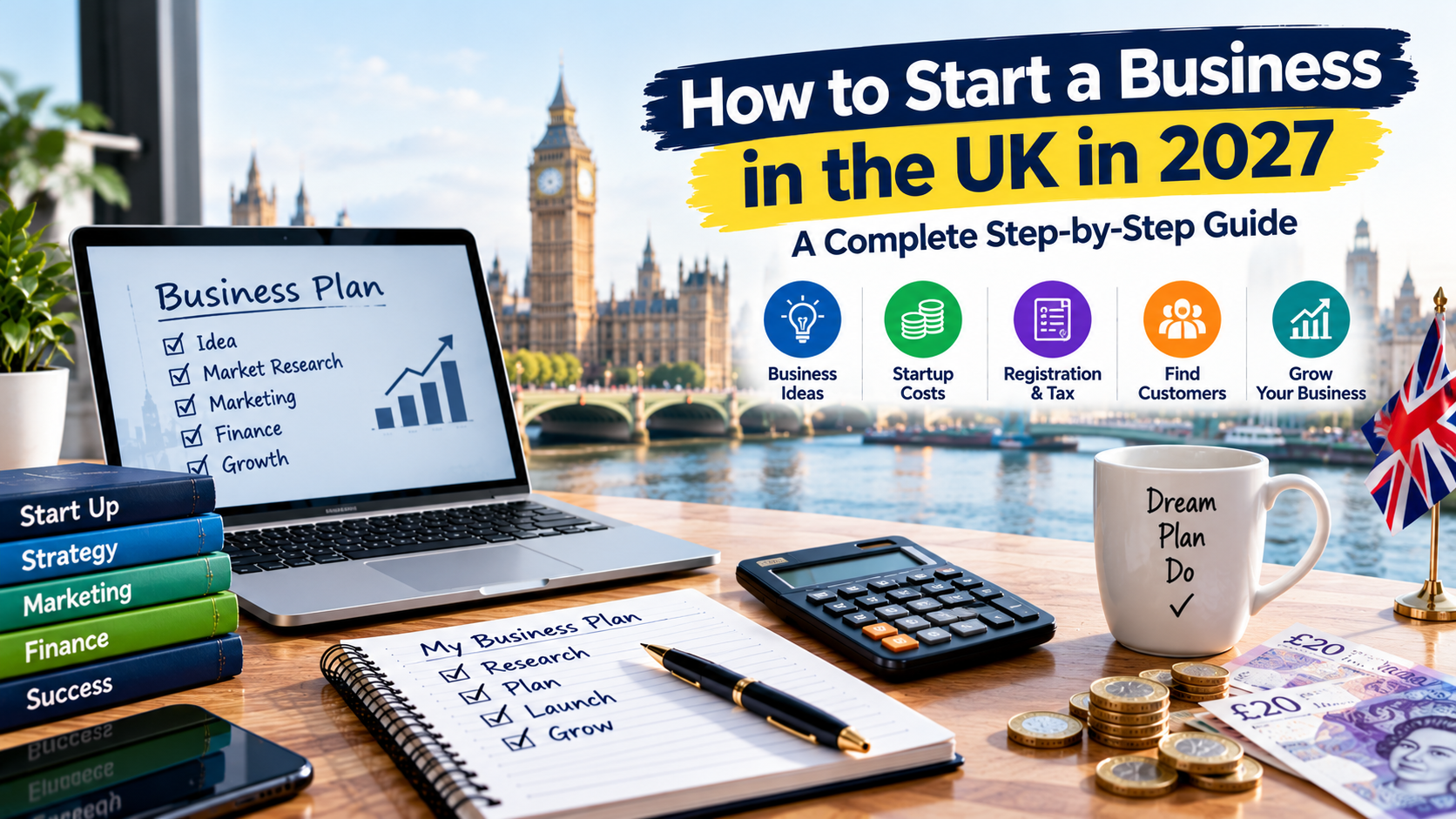
This guide explains how to start a business in the UK in 2027, from validating your idea and estimating costs to choosing a business structure, understanding tax requirements and finding your first customers. It is designed for beginners who want practical steps rather than complicated business terminology.
Important: Business costs, registration requirements and tax rules depend on your circumstances and may change. Treat examples in this guide as planning suggestions and check the latest official guidance before making financial or legal decisions.
Step 1: Choose a Business Idea That Solves a Real Problem
A strong business idea begins with a customer need. Instead of choosing an idea simply because it sounds profitable, identify a problem people are willing to pay to solve.
For example, busy households may need reliable cleaning services, small businesses may need help with social media, and local customers may be looking for affordable gardening or car-cleaning services.
Business ideas to consider in the UK
- Freelance services: Writing, graphic design, website creation, translation or administrative support.
- Home services: Domestic cleaning, gardening, ironing or other suitable household services.
- Online businesses: Selling handmade products, specialist accessories or digital products.
- Education: Tutoring, language lessons or skills-based training where you have the necessary knowledge.
- Automotive services: Mobile car valeting or other permitted vehicle-related services, with suitable training, insurance and equipment.
- Business support: Virtual assistance, bookkeeping if appropriately qualified, appointment management or social media services.
- Food businesses: Catering, baking or specialist food products, subject to applicable food safety and registration requirements.
Compare each idea by considering your existing skills, available time, startup budget, local competition and the likely cost of reaching customers.
How to identify a promising idea
- Write down three to five business ideas that match your skills and interests.
- Identify the specific customer who might buy each product or service.
- Research competing businesses and their prices.
- Speak to potential customers and ask what they currently struggle with.
- Estimate your initial costs and how much customers might realistically pay.
- Choose one idea to test before committing significant money.
The objective is not to find a business with guaranteed profits. It is to find an idea with a plausible market, manageable risks and a realistic way to earn revenue.
Step 2: Research the Market Before Investing
Market research helps you understand whether customers are likely to buy what you plan to offer. It can also reveal opportunities to differentiate your business from established competitors.
Research your potential customers
Start by answering these questions:
- Who is most likely to buy your product or service?
- What problem are they trying to solve?
- How do they currently solve that problem?
- What price range would be reasonable for them?
- Where do they search for businesses like yours?
- What would make them choose your business instead of a competitor?
Analyse your competitors
Search Google, Google Maps, business directories and relevant social media platforms for businesses offering similar products or services. Review their websites, service descriptions, customer feedback and publicly displayed prices.
Look for opportunities to compete through reliability, convenience, a specialist service, transparent pricing or better communication. Avoid assuming that a market is profitable simply because several competitors exist.
Test your idea before launching
You could create a simple landing page, offer a small pilot service, display sample products or speak directly with potential buyers. Where appropriate, seek genuine expressions of interest or pre-orders without promising anything you cannot deliver.
For example, before buying expensive car-valeting equipment, you could research local demand, calculate travel costs and investigate whether customers would pay enough to cover your time, supplies and insurance.
Step 3: Write a Simple Business Plan
A business plan does not need to be a lengthy document. A practical one-page plan can help you understand what you are selling, who will buy it, how much it may cost and how you will attract customers.
What your business plan should include
- Business concept: Explain what you will sell and the customer problem you will solve.
- Target market: Describe your ideal customer and the area or market you will serve.
- Competitive advantage: Explain why customers might choose you.
- Pricing: Estimate what you will charge and how you calculated your prices.
- Startup costs: List equipment, stock, software, insurance, registration and other initial expenses.
- Running costs: Estimate regular expenses such as transport, hosting, advertising and supplies.
- Marketing strategy: Explain how people will discover your business.
- Financial targets: Set realistic targets for sales, expenses and cash flow.
- Risks: Identify possible problems and how you could respond.
Set targets you can measure. For example, your first target might be to interview 15 potential customers, secure three paying clients or complete your first ten orders. These are planning targets, not guaranteed outcomes.
Step 4: Calculate Your Startup Budget
One of the most common mistakes new entrepreneurs make is calculating only the cost of buying equipment or creating a website. A business also needs money to operate while customers are discovering it.
Common startup expenses
- Equipment, tools and initial stock.
- Website hosting, domain registration and business software.
- Insurance and any necessary licences or training.
- Marketing materials and initial advertising.
- Packaging, delivery and transport.
- Professional advice or accounting support, where required.
- A reserve for unexpected expenses and slow sales.
Illustrative budget for a small service business
| Expense | Example budget |
|---|---|
| Basic equipment and supplies | £150 |
| Website and domain | £80 |
| Initial marketing | £100 |
| Insurance and administration allowance | £170 |
| Transport and working expenses | £100 |
| Emergency reserve | £200 |
| Total example budget | £800 |
This is an illustrative planning example, not a quotation or a universal cost estimate. Actual expenses will vary significantly by industry, location, equipment, insurance requirements and the type of work involved. Some businesses will need substantially more capital.
Separate startup costs from running costs
Startup costs are the expenses involved in getting your business ready to operate. Running costs are the recurring expenses required to keep it going.
Before launching, estimate how many months you can operate if sales are lower than expected. Avoid spending your entire budget on branding, equipment or stock before confirming that customers want your offer.
For more budgeting guidance, read our related article: How Much Does It Cost to Start a Business in the UK?
Step 5: Choose the Right Business Structure
Your business structure affects how you register, pay tax, maintain records and deal with business debts. In the UK, two common options are operating as a sole trader and setting up a limited company.
Option 1: Sole trader
A sole trader operates a business as an individual. This structure is often suitable for freelancers, independent service providers and people testing a small business idea.
Potential advantages include:
- A relatively straightforward setup.
- Direct control over business decisions.
- Less administrative complexity than running a limited company in many circumstances.
However, a sole trader is personally responsible for business debts. You must keep appropriate records and comply with tax obligations. You generally need to register for Self Assessment if your gross trading income exceeds £1,000 in a tax year, subject to the applicable rules and exceptions.
Official guidance: Set up as a sole trader on GOV.UK.
Option 2: Limited company
A limited company is a separate legal entity from its owners. It may be appropriate for businesses planning to grow, employ staff, bring in investors or work with customers who prefer dealing with a company.
However, incorporation brings additional responsibilities. Directors must follow company law, maintain records and submit the required accounts and filings. The company may also have Corporation Tax obligations.
Limited liability is not an absolute guarantee that an owner or director will never be personally liable. Personal guarantees, misconduct and other circumstances can create personal exposure.
Official guidance: Register a limited company on GOV.UK.
Which structure should you choose?
If you are starting a small, low-risk service business alone, sole trader status may be a practical starting point. If your business has higher risks, outside investment or more complex growth plans, compare the limited company option carefully.
There is no single structure that is best for everyone. Consider your liability, expected profits, administrative responsibilities and future plans. An accountant or qualified adviser can help you compare your options.
Step 6: Choose a Business Name and Build Your Brand
Your business name should be memorable, relevant to your offer and easy for customers to spell. Before using it, check for conflicts with existing businesses and any naming restrictions that apply to your chosen structure.
Practical branding steps
- Prepare a shortlist of possible business names.
- Search the internet and relevant official registers for existing names.
- Check whether a suitable website domain is available.
- Check social media usernames if you intend to use those platforms.
- Create a simple, consistent visual identity.
- Check trademark considerations before investing heavily in the name.
Do not assume that buying a domain name automatically gives you trademark rights or permission to use a name that belongs to another business.
Step 7: Register Your Business and Understand Your Tax Responsibilities
Once you have selected your structure, complete the registrations that apply to your business. The correct process depends on whether you operate as a sole trader, limited company, partnership or another structure.
If you operate as a sole trader
Check whether you need to register for Self Assessment with HM Revenue & Customs (HMRC). You may need to pay Income Tax and National Insurance depending on your circumstances and profits.
If you set up a limited company
You must register the company with Companies House before operating as an incorporated company. You will also need to understand the company's filing obligations, Corporation Tax responsibilities and rules for taking money out of the business.
Understand VAT
VAT registration is a separate consideration. Under the rules currently published by GOV.UK, compulsory registration generally applies when taxable turnover exceeds £90,000 over a rolling 12-month period or is expected to exceed that amount in the next 30 days. Different rules and exceptions can apply, so check the latest guidance.
Official guidance: When to register for VAT.
Keep accurate records
Record your sales, business expenses, invoices, receipts and relevant financial transactions. Good records make it easier to monitor profitability, prepare tax returns and understand where your money is going.
Consider using a spreadsheet or suitable accounting software from the beginning. Keep business and personal transactions clearly separated, and check whether your business structure requires a dedicated business bank account.
Important: Registration requirements and tax deadlines vary. Use the official government guidance rather than relying solely on online articles or social media advice.
Step 8: Check Licences, Insurance and Legal Requirements
Not every business needs a special licence, but some activities are regulated. Requirements depend on what you do, where you operate and how you deliver your products or services.
For example, a food business may need to register with its local authority before trading. Certain vehicle-related activities, childcare services, alcohol sales and other regulated activities may have additional requirements.
Before accepting customers, check:
- Whether your activity requires a licence, registration or permission.
- Whether you need public liability, professional indemnity or other insurance.
- Whether your home insurance, tenancy or mortgage conditions allow the intended business activity.
- Whether you must follow health and safety requirements.
- Whether consumer protection and refund rules apply to your sales.
- Whether your website or customer processes need privacy information and appropriate data protection measures.
- Whether you need employer-related registrations and insurance if you hire staff.
Use the official GOV.UK licence finder to investigate relevant licences. Check with your local authority or the relevant regulator when necessary.
Step 9: Create a Simple Website and Online Presence
A website can help customers understand what you offer, check your credibility and contact you. You do not need an expensive website to begin, but it should be clear, accurate and easy to use.
Essential website pages
- Home: Explain what your business does and whom it serves.
- Services or products: Describe your offer, pricing approach and important conditions.
- About: Explain your experience, approach and reasons customers can trust you.
- Contact: Provide a working contact method and relevant business information.
- Privacy information: Explain how personal information is handled where required.
- Terms and policies: Include appropriate terms, delivery, cancellation or refund information for your business model.
Make your website useful for Google and readers
Publish original content that answers genuine customer questions. Use descriptive page titles, clear headings, useful internal links, readable paragraphs and relevant image descriptions.
For a business website, useful content might include pricing guides, how-to articles, local service information, comparisons and answers to frequently asked questions.
Avoid publishing large numbers of repetitive or shallow articles just to target keywords. Focus on accuracy, originality and helping visitors make informed decisions. Search visibility takes time and cannot be guaranteed.
Step 10: Find Your First Customers
Getting your first paying customers is often more important than perfecting every detail of your brand. Start with a small, focused marketing plan and measure which activities generate genuine enquiries.
Practical ways to reach customers
- Personal network: Tell relevant contacts what you offer without pressuring them to buy.
- Local visibility: Where eligible, create an accurate business profile on relevant local directories and Google Business Profile.
- Social media: Share helpful content, examples of your work and clear information about your services.
- Direct outreach: Contact relevant businesses or potential customers with personalised, lawful messages.
- Partnerships: Explore relationships with complementary businesses that serve similar customers.
- Customer referrals: Ask satisfied customers to recommend your business or leave honest reviews.
- Search content: Answer specific questions that potential customers search for online.
Focus on one or two channels at first rather than trying to maintain every social media platform. Track enquiries, conversions and costs so you can identify what works.
Example: A simple 30-day launch plan
| Period | Main objective | Actions |
|---|---|---|
| Days 1–7 | Validate the offer | Research competitors, speak to potential customers and refine your service. |
| Days 8–14 | Prepare to launch | Confirm costs, complete necessary registrations and set up basic contact channels. |
| Days 15–21 | Reach potential customers | Publish useful content, contact relevant prospects and ask for feedback. |
| Days 22–30 | Improve the offer | Review enquiries, follow up appropriately and refine pricing or messaging. |
This schedule is a starting point rather than a guarantee of sales. Regulated activities and businesses requiring equipment, premises or approvals may need more preparation before launching.
Step 11: Manage Cash Flow and Measure Performance
A business can generate sales and still experience financial difficulties if money arrives too late to cover its bills. Cash flow management helps you understand when money is expected to come in and when payments are due.
Monitor these key numbers
- Revenue: The income generated from sales before deducting expenses.
- Direct costs: Expenses directly associated with delivering a product or service.
- Gross profit: Revenue minus the relevant direct costs.
- Operating expenses: Other costs required to run the business.
- Cash balance: The money currently available to the business.
- Outstanding payments: Money customers owe you and bills you must pay.
Calculate your break-even point
Your break-even point is the level of sales at which revenue covers the relevant costs. A simple calculation for a single product or service is:
Break-even sales volume = Monthly fixed costs ÷ Contribution per sale
Contribution per sale is the selling price minus the variable cost of delivering that sale.
Example: Suppose you charge £60 for a service, spend £15 on variable costs for each booking and have £450 in monthly fixed costs.
- Price per booking: £60
- Variable cost per booking: £15
- Contribution per booking: £45
- Monthly fixed costs: £450
- Break-even volume: £450 ÷ £45 = 10 bookings
You would need 10 bookings to cover the stated costs under these assumptions. This example excludes other potential costs, tax, owner remuneration and changes in demand. Breaking even does not necessarily mean the business provides an adequate income.
Step 12: Explore Funding Carefully
Many small businesses begin with personal savings or income from early sales. Other businesses may need external funding to purchase equipment, develop products or pay for initial operating expenses.
Potential options include:
- Personal savings: Can avoid borrowing costs but put personal money at risk.
- Early customer revenue: Can help fund growth when the business model allows it.
- Business loans: Require careful consideration of repayments, interest and eligibility.
- Grants: May be available for particular activities, locations or applicant groups, but eligibility and availability vary.
- Investment: May suit scalable businesses but can involve giving up ownership or control.
- Government-backed support: Explore current programmes and eligibility criteria through official business support resources.
Start by calculating exactly how much funding you need and what it will pay for. Compare the total cost and conditions of any borrowing, and avoid assuming that a grant or loan will be approved.
Explore official guidance through Business.gov.uk: How to start a business.
Common Mistakes to Avoid When Starting a Business
- Spending too much too early: Test demand before committing to expensive equipment, premises or stock.
- Ignoring competitors: Understand what customers already have and why they might choose you.
- Pricing without calculating costs: Include materials, time, delivery, overheads and other relevant expenses.
- Neglecting administration: Keep records and meet the legal and tax requirements that apply to your business.
- Relying on one customer: Where possible, build a broader pipeline of potential customers.
- Confusing sales with profit: Revenue is not the same as the money left after expenses.
- Expecting immediate results: Building trust, customer relationships and consistent sales often takes time.
- Copying competitors: Learn from the market, but develop your own useful offer and original content.
Frequently Asked Questions
1. How much money do I need to start a business in the UK?
There is no single amount. Some freelance or online service businesses can begin with relatively little money, while businesses involving stock, premises, vehicles or specialist equipment may require much larger investments. Calculate your specific startup and running costs before launching.
2. Can I start a business in the UK from home?
Yes, many businesses can operate from home, including freelance services, online shops and certain administrative services. However, check planning rules, your tenancy or mortgage conditions, insurance and any sector-specific requirements that apply to your activity.
3. Do I need to register a business before making my first sale?
The answer depends on your business structure and circumstances. A sole trader can generally begin trading without registering a company, but must register for Self Assessment when the relevant requirements apply. A limited company must be registered with Companies House before it operates as an incorporated company.
4. Is a sole trader better than a limited company?
Neither option is best for everyone. Sole trader status can be simpler to administer, while a limited company is a separate legal entity with different reporting, tax and liability arrangements. Compare the responsibilities and risks before choosing.
5. Do I need a business bank account?
A dedicated account can make it easier to separate business and personal transactions. A limited company generally needs its own company bank account because its finances are separate from those of its owners. Check the requirements and terms of your chosen bank and business structure.
6. How can I get customers without spending much on advertising?
Start with customer conversations, referrals, relevant local visibility, helpful social media content and personalised outreach. Focus on activities that reach your intended audience and measure which ones generate real enquiries.
7. Do I need an accountant when starting a business?
You may be able to handle straightforward administration yourself, but an accountant can help you understand tax, records and business structure choices. Professional support may be especially useful if your circumstances are complex or your business grows.
8. Can I run a business while working or studying?
Potentially, provided you comply with your employment contract, study conditions, immigration permissions where applicable and any other relevant restrictions. Choose a business model that fits your available time and responsibilities.
Official UK Business Resources
Use these official resources to check the rules that apply to your situation:
- Business.gov.uk — How to start a business
- GOV.UK — Set up a business
- GOV.UK — Set up as a sole trader
- GOV.UK — Register a limited company
- GOV.UK — VAT registration guidance
- GOV.UK — Find a business licence
Conclusion: Take the First Practical Step
Starting a business in the UK in 2027 does not require you to have every detail figured out on day one. What matters is choosing a sensible idea, understanding your customers, preparing a realistic budget and meeting the requirements that apply to your activity.
Begin with research, test your offer on a small scale and keep careful records of your costs and sales. Build a simple online presence, communicate clearly with customers and improve your business using real feedback.
Most importantly, make decisions based on evidence rather than promises of quick profits. A carefully tested idea and consistent execution can put you in a stronger position to build a sustainable business over time.
For more practical ideas, startup budgets and business guides, explore UKBusinessIdeas.com.